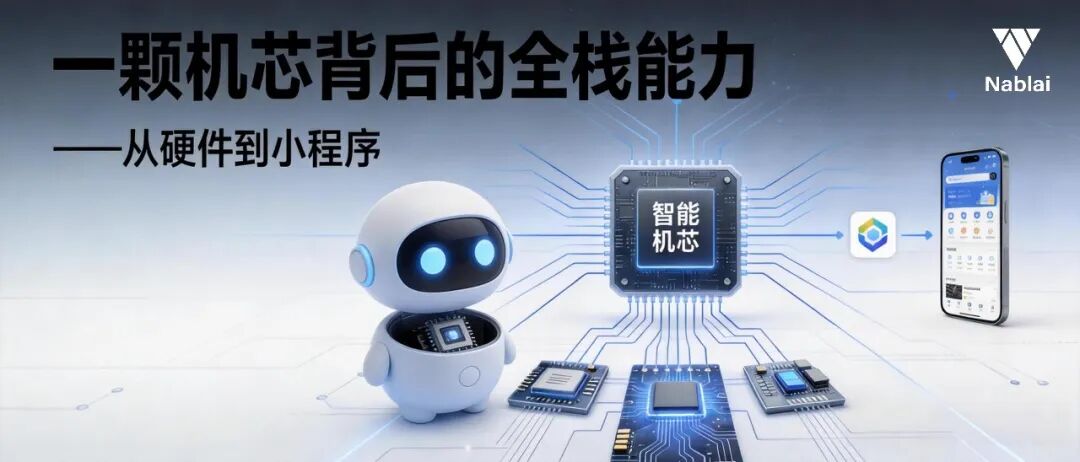
Most customers come to us thinking they are buying an AI module. They only discover after signing the contract that what they have received is far more than a board: hardware, firmware, cloud platform, Mini Program, admin console, LLM integration, OTA updates and the account system — the whole stack, ready to go. This article sets out exactly what Nablai delivers, and why it saves a toy factory half a year of development time.
1. What customers thought they were buying: just a module
The first time almost every customer contacts us, the questions are pretty much the same:
“What does the module cost?”
“Which LLMs does it support?”
“Will it fit inside this plush toy?”
These questions are perfectly normal. After all, “AI intelligent module” sounds like a piece of hardware: buy it, solder on a speaker and a battery, drop it into the shell, done.
But by the second week of the project, customers usually ask a different question:
“What about the app?”
Only then do we bring out the full list. A common first reaction is: “You should have said so earlier — I thought I would have to hire someone to build this myself.”
2. A module is only the tip of the iceberg
An AI toy looks like “one module plus a plush shell”, but what actually makes it run is an entire system behind it.
Broken down, the full delivery has this structure:
Hardware layer: LX/TY series intelligent modules handling voice capture, playback, connectivity and camera input
Firmware layer: the embedded system handling device wake-up, provisioning, OTA reception and sensor management
Cloud platform: device connectivity, LLM orchestration, content delivery and data storage
Application layer: the branded Mini Program and app, covering user sign-up, device binding, character management and chat history
Admin console: customer management, device management, bulk agent configuration and analytics dashboards
AI capabilities: LLM integration, character persona customisation and MCP knowledge-base connectivity
Miss any one of these six layers and the product simply does not run.
Most solution providers on the market only supply the first two layers: here is your module, the firmware is already flashed, sort out the other four layers yourself. Only after the factory receives the module does it discover where the real engineering sits: hiring an outsourcer to build the Mini Program, a team to set up the admin console, working out for itself how to connect the LLM, how to do OTA and how to design the account system.
A project running six months late is entirely normal.
3. The six layers we deliver, taken one at a time
Layer 1: Hardware modules
The LX series is based on the ESP32 platform, supporting cameras, 4G connectivity and a wide range of sensors — suited to high-performance AI toys and vision-led products.
The TY series is based on the Tuya platform, supporting more than 60 languages and deployment across global data centres — built for products going overseas.
What the customer receives is a module with the hardware design already completed and validated for mass production: connect power, a speaker and a microphone, and it works.
Layer 2: Embedded firmware
The firmware is already flashed when the module ships. Provisioning logic, wake-word response, OTA reception and device status reporting are all pre-installed.
The customer does not write a single line of embedded code. Line workers assemble to the SOP, power it up, and it is ready for test.
Layer 3: Cloud platform
Device connectivity, LLM calls, content delivery and data storage all happen in the cloud.
The customer does not need to buy servers, stand up an IoT platform or handle high concurrency. Devices come online and are onboarded; data flows back to the brand's admin console automatically.
Layer 4: The branded Mini Program and app
This is the layer customers feel most directly. Users scan a code into the brand's own Mini Program and can:
- Sign in quickly with their phone number
- Bind the device over Bluetooth provisioning
- Device list management
- Create and switch between characters
- Browse chat history
- Read a daily interaction summary
- See usage-time statistics
The Mini Program belongs to the brand, and so does the user data — change the logo and the colour scheme and it is ready for launch.
Layer 5: Admin console
The brand logs into the console and can:
- Manage users and query device status
- Archive chat history and run data analysis
- Bulk-configure the default agent for devices by product ID
- Connect a knowledge base over MCP and keep the content updating
- Push firmware OTA updates remotely
One command, and every online device takes effect at once.
Layer 6: AI capabilities
Any LLM can be connected: general-purpose models, museum and cultural-heritage specialists, education models, or a brand's own fine-tuned model.
Character personas are fully customisable: wake word, voice, tone, IP world-building and a dedicated knowledge base.
Combined with the account system, each user gets their own memory, synchronised across devices.
4. Why these six layers have to be delivered together
Look at each layer on its own and you can find a supplier for it.
Hardware from solution provider A, Mini Program from outsourcer B, admin console from team C, LLM connected to D's API — can you bolt them together and have it work? In theory, yes.
In practice you run into three problems:
First, the interfaces do not line up. Provider A's module firmware and provider B's Mini Program use incompatible provisioning protocols; after two weeks of integration testing you discover you have to change the underlying layer.
Second, responsibility gets blurred. When a user fails to bind, is it the module, the Mini Program or the cloud platform? All three point at each other and the project stalls.
Third, iteration drifts apart. The module ships a new feature over OTA but the Mini Program has not caught up; the console changes the agent configuration and the firmware does not recognise it.
Delivering all six together means the interfaces are aligned inside our own organisation, one company answers for the problems, and iteration runs on a single rhythm.
That is what “turnkey” really means: not six things packaged up and sold to you, but six things that were always one system.
5. What the customer actually saves
If a toy factory built this stack itself:
- Hire 2 backend engineers, 1 frontend engineer, 1 Mini Program developer and 1 product manager
- Spend half a year in development
- Pay for servers and operations
- Spend time on endless integration testing and QA
That is comfortably over a million in cost, with a timeline of six months or more.
With our full-stack solution:
- Plug the module in directly and launch the Mini Program with your own skin
- Create a console account and start using it
- Let us configure the LLM integration
- Let us maintain the OTA channel
What you save is not money — it is half a year of market window.
The window for AI toys will not stay open forever. Whoever ships first gets the user feedback first and iterates first. Being six months late can put you a whole step behind.
6. What we deliver is a product that runs
Back to the title: what do we actually deliver?
Not a module. A complete system — from hardware to Mini Program, from cloud to admin console, from AI capabilities to OTA updates.
The customer takes it home, fits it into the shell, adds the packaging, and it is ready for the shelves.
We build the module. We build the system. The rest is yours.
Shenzhen Nablai Intelligent Technology Co., Ltd. — AI module specialists for smart toys
📧 contact@nablai.com.cn 🌐 www.nablai.com.cn