Nablai 2026-11-02 17:37
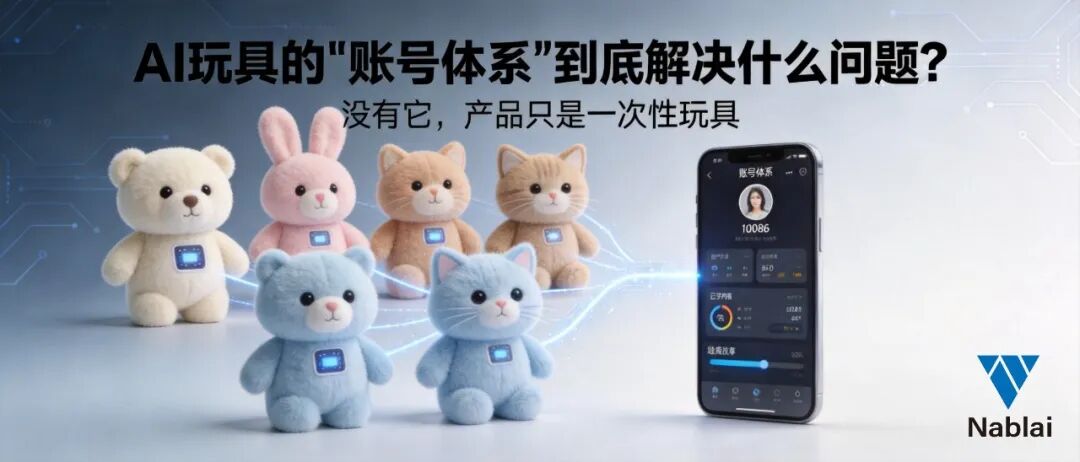
Summary: When toy makers build AI toys, they tend to pour all their energy into AI module selection and model integration and ignore the account system. After the product ships: nobody knows who the user is, device status is invisible, chat history cannot be saved, and switching to a new toy wipes all memory. An account system is not just "setting up Wi-Fi" — it decides whether an AI toy is a "one-off product" or an "operable smart device." This article explains exactly what an account system solves.
1. First Problem the Account System Solves: Who Does the Device Belong To?
Without an account system, an AI toy is "naked" — anyone who picks it up can use it, but nobody knows whose device it actually is.
With an account system, the logic becomes:
- User scans a QR code to log in, and the device binds to the account
- One account can bind multiple devices
- When a device changes hands, the new user can pair and bind it, and the previous user's data is retained
- If a user unbinds voluntarily, the data is not lost
It looks like a technical detail, but for a brand it means: every device sold has an identifiable real user behind it.
2. Second Problem the Account System Solves: Who Owns the Data?
Many AI toy solutions on the market use a generic shared app — all brands share one entry point, and all user data accumulates on the solution provider's servers.
That means: the users are not yours, the data is not yours, and there is no direct connection between the brand and its users.
With an independent account system, the data logic is completely different:
- Users register in the brand's own mini-program / app
- Device binding relationships live in the brand's backend
- Chat history, interaction summaries and usage time all accumulate on the brand's side
- The brand can export user data at any time, without depending on a third party
Whoever holds the data owns the users.
3. Third Problem the Account System Solves: Can the Experience Be Continuous?
The core value of an AI toy is "companionship," and companionship presupposes "remembering."
With an account system, memory is no longer temporary storage on the device — it is a long-term archive under a cloud account:
- The child's name, preferences and fears told to the toy are stored under the account
- Switch to a new toy of the same brand, log into the same account, and memory is restored
- Multiple devices at home (the bear in the living room, the pendant on the backpack) share synced conversation history
- Family members share one account, and the toy can tell brother from sister, remembering each separately
Without an account system, changing devices means starting over. With one, the relationship between the user and the toy can continue.
4. Fourth Problem the Account System Solves: Can the Brand Operate Its Users?
Once an AI toy is sold, the relationship between brand and user has only just begun.
With an account system, the brand can:
- View user lists and device binding relationships
- Monitor device online status and activity
- Push new content and new features through the backend
- Analyze trending topics in chat history to guide product iteration
- Send holiday greetings and new-product notices with user consent
Without an account system, none of this is possible. Between brand and user there is only one transaction, with no ongoing connection.
5. An Account System Is Not "Setting Up Wi-Fi" — It Is Product Infrastructure
Many clients hearing "account system" for the first time assume it just means users scan a code to pair the device.
Pairing is only the entrance. What an account system really solves:
| Question | Without an account system | With an account system |
|---|---|---|
| Who does the device belong to? | Unknown | Bind to a specific user |
| Who owns the data? | Solution providers | Brand owners |
| Memory after switching devices | Wiped | Restored from the cloud |
| Multi-device management | Not supported | One account, multiple devices |
| Family member distinction | Not supported | Supports independent memory for multiple users |
| Can the brand reach users? | No | Push-capable, operable |
| User profiles | No | Chat history, usage time, interaction summaries |
6. Nablai's Account System Capabilities
The account system of the Nablai LX/TY Series covers the full chain from binding to operations:
User side (mini-program / app):
- WeChat one-tap phone login
- Bind the device over Bluetooth provisioning
- Device list, status view, volume control
- Device unbinding and change of ownership
- Create and switch between characters
- Chat history query and daily interaction summaries
- Usage time and word-frequency statistics
Brand backend:
- User management and device binding queries
- Device online status and firmware version management
- Bulk agent (character) configuration
- Data dashboards and user profiles
- OTA push and content updates
Data ownership: all user data, device data and conversation data accumulate in the brand's own backend — it never passes through the solution provider.
7. Conclusion
The essential difference between an AI toy and a traditional toy is not "can it talk" — it is "can it build a lasting user relationship."
The account system is where that relationship starts. Without it, selling the AI toy is the end; with it, selling it is the beginning.
For toy makers now evaluating solutions, the question worth asking a provider is not "how much is the module?" but rather — "Where is the user data stored? Whose account system is it?"
Shenzhen Nablai Intelligent Technology Co., Ltd. — AI module specialists for smart toys
📧 contact@nablai.com.cn 🌐 www.nablai.com.cn