Nablai April 15, 2026, 19:20
Introduction
You want to build an AI toy but have no idea where to start?
Some teams hold a well-known IP and just want to give the character the ability to talk, fast. Some brands chase the ultimate experience and want every interaction detail deeply customized. Others are chasing value for money and want to test the market at the lowest possible cost.
Faced with needs this varied, one "universal" technical solution is simply not realistic.
Nablai's answer is: Do not build one product; build a solution set you can compose.
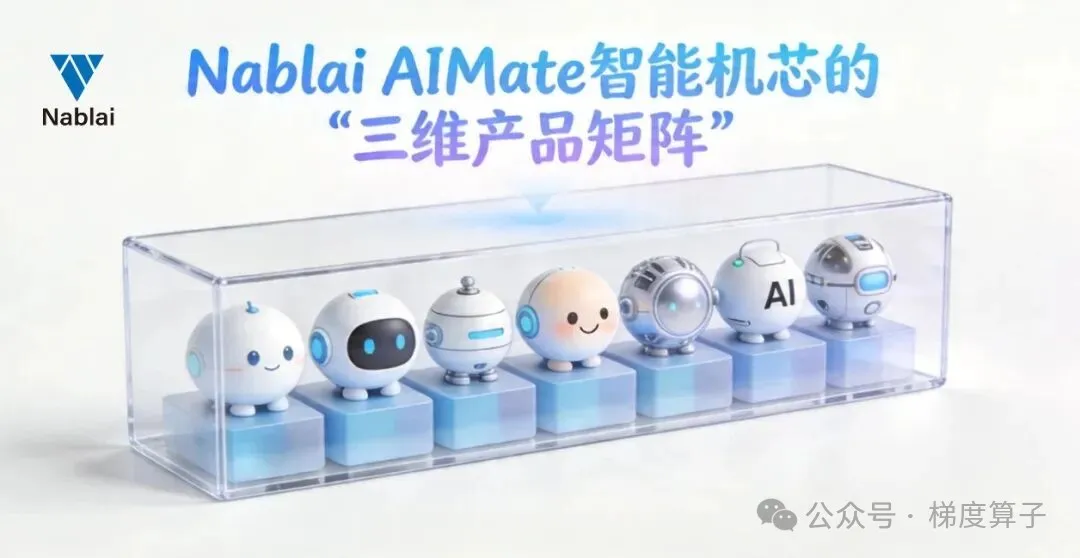
And that is what we want to talk about today: the three-dimension product matrix of the AIMate AI module 。
What is a "three-dimension product matrix"?
Put simply, it is three dimensions you can combine freely:
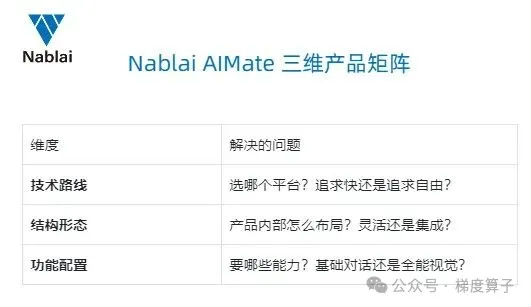
The three dimensions work like three dials: turn them to the setting that best fits how you are positioning your product.
Let us take them apart one at a time.
Dimension 1: Technology Platform - A Two-Platform Strategy
Nablai offers two technology platforms, each aimed at a typical set of requirements.
TY platform (Tuya): fast global expansion, worldwide deployment
- Core strengths: Deep integration with Tuya's mature IoT ecosystem, plug and play
- Language support: Covers 60+ languages worldwide, so nothing blocks your global expansion
- Use cases: Customers who want to validate a market fast and build a global footprint
- In one sentence: Fast, stable and global: choose TY
LX platform (ESP32): brand customization, technical freedom
- Core strengths: Built on the high-performance ESP32-S3 chip, developed entirely in-house
- Open capabilities: An open model layer that connects flexibly to leading Chinese and international LLMs
- Value-added services : End-to-end customization of your own app and admin console
- Use cases: Customers chasing brand differentiation and deep customization
- In one sentence: Freedom, depth and exclusivity: choose LX
One tip: Neither platform is absolutely better than the other. The only question is which one matches your product strategy.
Dimension 2: Physical Structure - Split or All-in-One
The same technology platform can be built in different physical structures depending on the internal space and cost targets of your product.
Split structure
- Design: The main board and the control board are separate
- Strengths: Structurally flexible and easy to build into toys with complex shapes
- Best for: Irregularly shaped products and complex designs where space is tight
All-in-one structure
- Design: Core modules integrated at a high level
- Strengths: Highly integrated and more cost-effective
- Best for: Standardized product lines and projects where value for money matters
For example: A plush toy with a complex shape is usually better served by a split structure, while a standardized desktop companion robot does fine with an all-in-one structure.
Dimension 3: Feature Configuration - Four Editions, Four Capability Sets
This is the most intuitive dimension: what kind of "brain" do you want to give your product?
A edition | Base edition
- What is included: AI voice interaction, touch interaction, shake sensing, vibration feedback
- Best for: Entry-level AI toys, AI care and companion devices
- In one line: It listens, it talks, and it feels touch and shaking
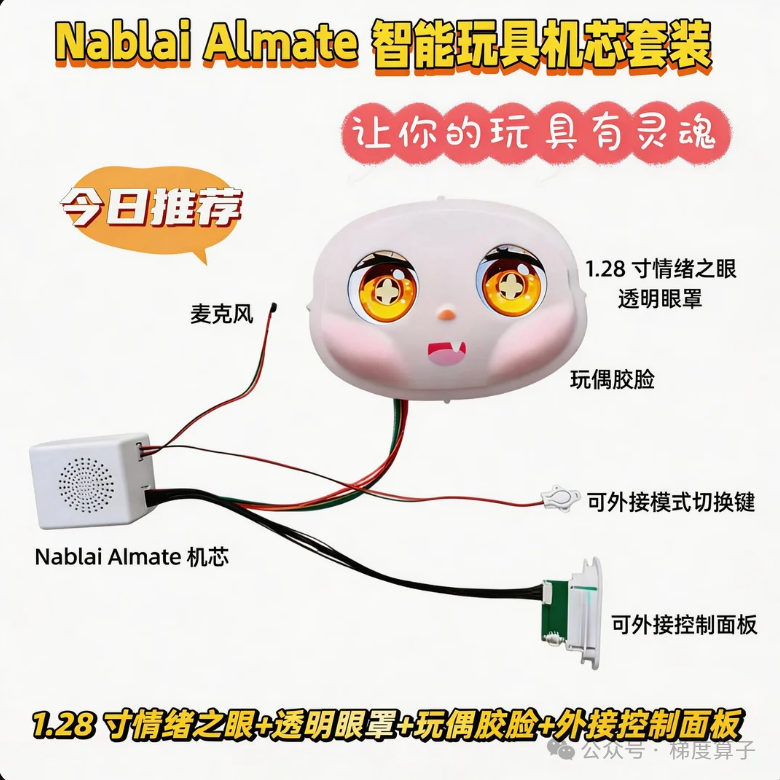
V edition | Vision edition (A edition + vision)
- What is added: Camera-based visual perception, image recognition, visual interaction
- Best for: Vision-interaction products, educational devices
- In one line: Give your product a pair of eyes
T edition | Storage edition (A edition + storage)
- What is added: TF card storage expansion, local content storage, offline content playback
- Best for: Offline content products, interactive devices
- In one line: Tells stories even with no network
S edition | Flagship edition (A edition + vision + storage)
- What is included: Everything in the A edition + camera + TF card storage
- Best for: High-end AI companion devices, smart interactive terminals
- In one line: The all-rounder, with a fully loaded experience
Putting It Together: From Requirements to a Solution
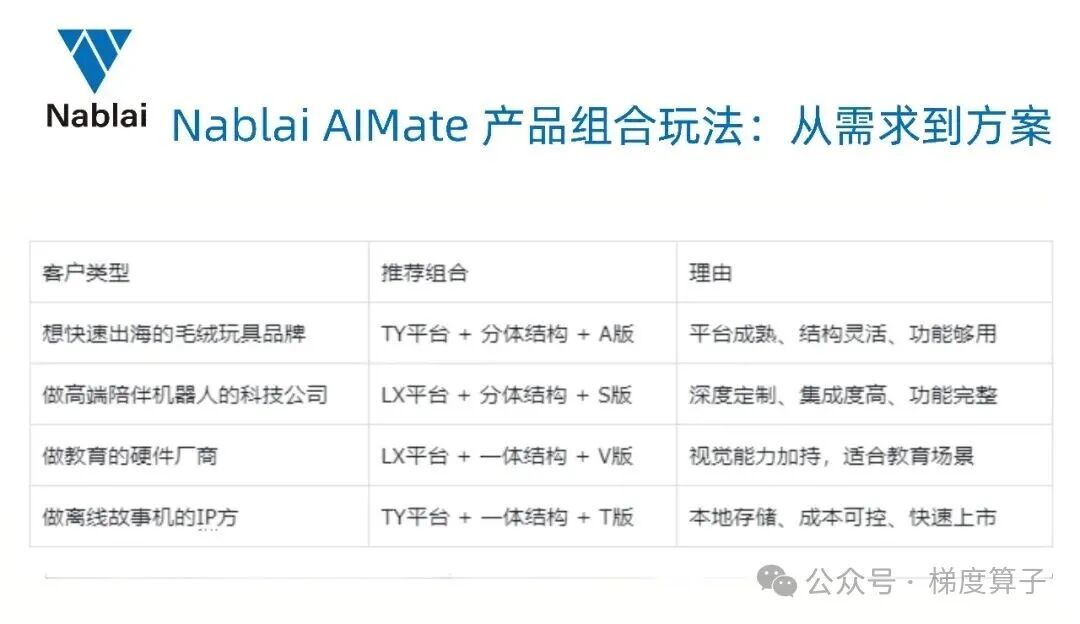
Combine the three dimensions freely and you get dozens of possible configurations.
A few typical examples:
Where is the value in this matrix?
For customers
- A lower barrier to entry: No need to design the technical solution from scratch
- Shorter timelines: Mature modules are plug-and-play, and you can reach mass production within a few months
- Cost control: You pay only for the features you need, with nothing wasted
- Flexible upgrades: The same product line can reuse different configurations
For Nablai
- Covers every scenario: From entry level to high end, from simple to complex
- Fast response: Almost anything a customer asks for is already in the matrix
- Continuous evolution: New capabilities join the matrix as new editions
In closing
Developing an AI toy should not mean reinventing the wheel.
The three-dimension product matrix of the Nablai AIMate AI module is, at its core, a piece of modular, composable and extensible technical infrastructure.
You only need to answer three questions:
- Technology platform: Fast, or free?
- Physical structure: Flexible, or integrated?
- Feature configuration: Base, or flagship?
Leave the rest to Nablai.
Powered by Nabla · Optimized by AI
Powered by Nabla · Optimized by AI
Keep scrolling for the next one
Nablai
Scroll up for the next one
Shenzhen Nablai Intelligent Technology Co., Ltd. — AI module specialists for smart toys
📧 contact@nablai.com.cn 🌐 www.nablai.com.cn