Nearly every AI module solution on the market that claims to be "customizable" stops at swapping the logo and changing the UI colors.
What the LX Series sets out to do is hand over six complete areas of technical sovereignty, one at a time, to the brand owner.
1. Brand Sovereignty Anxiety: The Most Expensive Anxiety of 2026
It is 2026 and a toy brand has just sold 100,000 AI toys. What happens next?
Ending one (the common one): the app carries the solution provider's logo, user data runs in the solution provider's cloud, and subscription revenue is split 3:7 or 4:6 with that provider. The more you sell, the further you drift from your own users. Who owns the online activity and retention data across those 100,000 units? Nobody knows. Who owns the users' conversation preferences and content consumption data? Nobody knows. Who owns the channel that reaches them when you push a new story for the holidays? Nobody knows.
Ending two (the rare one): the app carries your logo, user data accumulates in your own back end, and 100% of the subscription revenue is yours. The more you sell, the thicker your user asset gets: 100,000 online users are a gold mine you can push content to with precision, use to iterate the product, and even use to incubate new SKUs.
The difference is not the hardware, because hardware converges sooner or later. The difference is control.
These six sovereigns of the LX Series are every technical capability the second ending requires, packaged up and delivered into the brand owner's hands.
2. Start with the Architecture: Device, Cloud and Application - Three Layers, Each One a Brand Asset
The LX Series four-layer architecture: application layer → cloud layer → device layer → AI layer
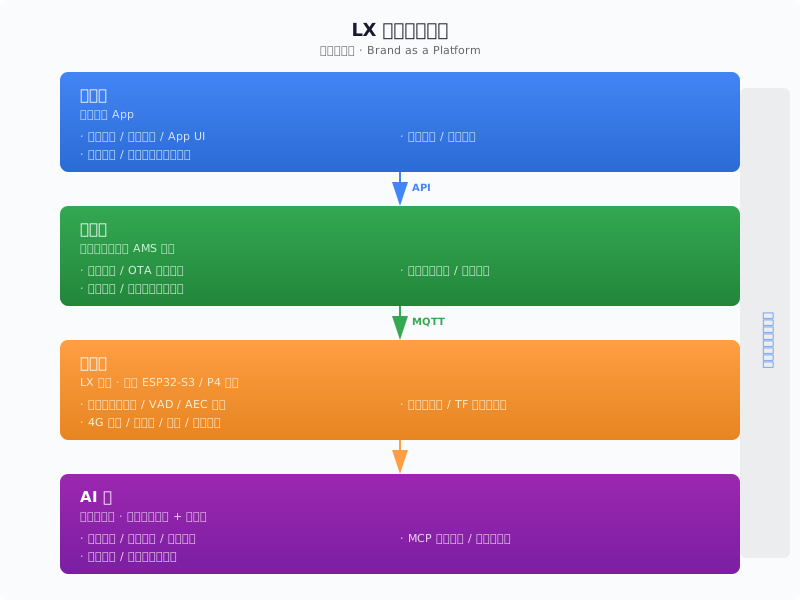
In a conventional module cloud platform solution, the architecture puts "platform first, brand behind": the brand owner is just one customer of the platform, and the data, the rules and the iteration cadence of every layer are defined by the platform.
The LX Series turns that around: brand first, platform behind. Nablai supplies the foundation - the module, AMS, the model framework and the app SDK - but the specific configuration of each layer, the operating rules and data ownership all belong to the brand owner.
Understand that architectural difference and the six sovereigns below will make sense.
3. Sovereignty 1: An Independent Account System - You Decide Who the User Belongs To
Deliverables
The brand owner runs its own user registration and login system (phone number, WeChat, Apple ID and other login channels)
Core user information, device binding relationships, usage records and AI conversation logs are all retained in full
The account system is deployed independently inside the brand owner's AMS console, physically isolated from Nablai's own technology platform
What does this give the brand owner?
(1) User assets that compound
A child who talks to a toy for 20 minutes a day generates 10 hours of real interaction data in a month. That data covers:
which topics, stories and facts the child likes
the child's language habits and emotional patterns
the household's spending bracket and the topics parents are sensitive about
peak conversation hours and how often the device gets used
Sitting in the brand owner's own database, this data is a mine worth working:
precise segmentation when you push a new story or a new feature
real usage data to back the next generation of the product
a user-profile foundation when you move into value-added services
(2) Cross-device user recognition
An independent account system means a user's multiple devices - the plush toy in the living room, the story player by the child's bed, the small speaker they take out with them - can all be bound to one user ID and form a single unified profile. With module cloud platform solutions, the account systems behind different devices do not interoperate, and that is the single biggest obstacle to building user LTV (Life Time Value).
(3) Full control of the membership system
Subscription membership, points, growth levels and paid content tiers are all defined by the brand owner. The AMS console on the LX Series supports flexible membership configuration: monthly / quarterly / annual / trial plans, auto-renewal, tiered pricing and member-only features.
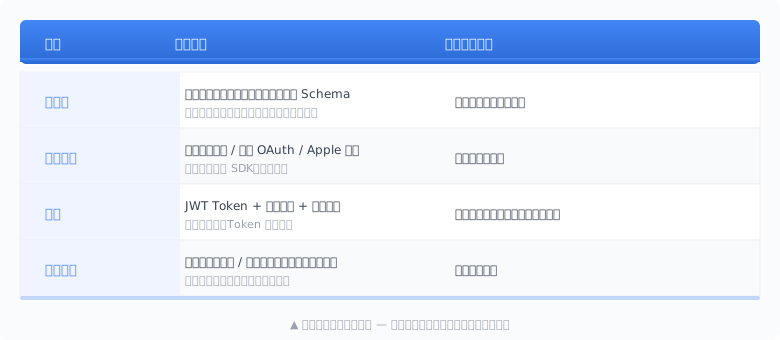
Technical detail: how is the account system built?
The LX Series account system is delivered white-box:
Independent account system delivery checklist: the four layers of database, login service, security and user operations
Real scenarios
The first thing one designer toy brand did after adopting LX was to use the app registration rate as a proxy for product reputation. For every new SKU launch they look at the ratio of registered accounts to units sold: a high registration rate means people really use it and retention is high; a low rate means the product failed to hold their attention. With a module cloud platform solution that data is simply unobtainable, because every user is a platform account.
4. Sovereignty 2: Your Own Branded App - Your UI, Your Accounts, Your Store Listing
Deliverables
App UI, UX, icons, splash screen and motion, all built to the brand owner's design files
The app is published under the brand owner's own developer account (Apple Developer Account / Google Play Console / domestic app stores)
App feature modules (device binding, provisioning, conversation history, subscriptions, settings) are built on the LX SDK
What does this give the brand owner?
(1) The app store listing is yours
This is the sovereignty that most often gets overlooked. Plenty of brand owners publish their app under the solution provider's developer account, which means:
the risk of the app being pulled or the account being banned sits with the solution provider's account
store reviews and ratings are outside your control
the app name and icon are managed by the solution provider
With the LX Series brand-owned app, ownership of the app store listing is 100% the brand owner's. Even if the brand owner ends its relationship with Nablai one day, the app and the users stay in your hands.
(2) Brand consistency
The LX SDK ships with a complete UI component library and interaction framework, but the visual language is defined by the brand owner:
brand colors, typefaces and icon style
emotional design for onboarding, empty states and error pages
micro-interaction details (button feedback, transition motion, loading animations)
We delivered an app for a "panda IP" AI toy where the entire UI followed a gentle, soothing aesthetic, and even the error page was an animation of the panda rubbing its eyes. No OEM white-label app can deliver that level of detail.
(3) Freedom to extend features
Brand owners can build brand-specific features of their own on top of the LX SDK:
IP collaboration campaign pages (a limited-time Kakalong x animation-IP campaign)
a membership growth-points system (users earn 10 points for every hour of conversation)
a content store (virtual goods sold alongside subscriptions)
community features (parent community, user-generated content)
Technical detail: how is the app delivered?
The LX Series offers two app delivery models:
| Model | Use cases | Delivery lead time |
|---|---|---|
| White-box SDK | Brand owners with their own app development team | 1-2 weeks to integrate |
| Custom development | Brand owners without an app team | 45 days on average |
Under both models, ownership of the finished app belongs to the brand owner: source code, developer account and store listing are all handed over.
5. Sovereignty 3: A Custom LLM - You Define the AI Persona, and Accountability Is Clear
Deliverables
LLM integration: DeepSeek, Qwen, ERNIE Bot, ChatGLM, Llama and other mainstream models are all supported
Model fine-tuning framework: build a dedicated persona from conversation samples supplied by the brand owner
Safety filtering: an on-device sensitive-word library plus cloud-side content moderation, a double safeguard
MCP tool-calling protocol: the model can plug into external capabilities such as weather, music and calculation
What does this give the brand owner?
(1) An exclusive AI persona
Custom LLM fine-tuning workflow: samples → annotation → LoRA fine-tuning → A/B testing → independent deployment
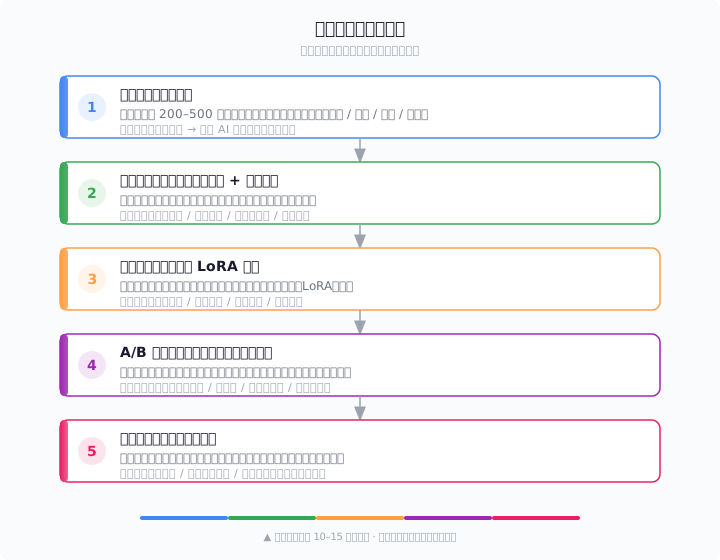
One case we ran involved a dinosaur-IP toy. After fine-tuning, the model spoke like "Wow, you're amazing, kid. Want to come exploring with me?", where the general-purpose model answered "Sure, okay". That difference in tone is exactly what makes an IP recognizable.
(2) Freedom to choose the model
Different models are strong in different areas:
DeepSeek: exceptionally good Chinese conversation and solid logical reasoning
Qwen: a rich Chinese training corpus and smooth multi-turn conversation
ERNIE Bot: a strong domestic compliance posture
Open-source Llama / Qwen: friendly to private deployment
Hybrid routing architecture: use a lightweight model for everyday chat to hold costs down, and route deeper conversations to a stronger model
The LX Series does not lock you into a model. Brand owners pick the base model that best fits their product positioning, budget and compliance requirements.
(3) Clear lines of accountability for safety
AI content safety is the most sensitive compliance topic of 2026. The LX Series uses a two-layer safeguard:
| Layer | Mechanism | Role |
|---|---|---|
| On-device | Local sensitive-word library + keyword-triggered blocking | No network dependency, zero-latency response |
| Cloud | The LLM's built-in safety filters + the brand owner's own moderation rules | Compliance checks in complex contexts |
The key point: responsibility for content safety sits with the brand owner,not with the solution provider. The LX Series provides the tools and the mechanisms, but responsibility for designing conversation content and for compliance review rests clearly with the brand owner. That gets written into the contract, which avoids arguments later.
Technical detail: wiring up the MCP protocol
MCP tool-calling architecture: custom LLM ↔ MCP protocol ↔ tool server (weather / music / calculator / translation / stories)
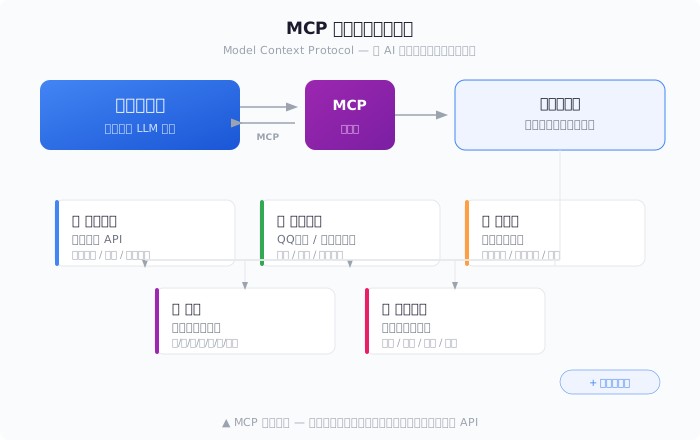
Brand owners can connect any MCP-compatible tool service their product needs, so the capabilities of an AI toy keep evolving.
6. Sovereignty 4: Your Own AMS Console - Devices, Users and Content, All Under Your Control
Deliverables
AMS (AI Management System) is deployed independently into the brand owner's own cloud environment (public cloud / private cloud / hybrid cloud)
Device management: activation, binding, unbinding, status monitoring and OTA updates
User operations: account management, behavior analytics, user segmentation and push channels
Content operations: story library management, knowledge base management, conversation template configuration and holiday campaign configuration
What does this give the brand owner?
(1) Device lifecycle management
With 100,000 AI toys online, no two units are in the same state:
which devices are online and which are offline
which devices are low on battery and which have a faulty microphone
which devices upgraded successfully and which failed and need a rollback
which devices produced conversation content that tripped a sensitive word
The AMS console provides a complete device monitoring dashboard, so hardware after-sales issues are settled with data instead of manual troubleshooting.
(2) Your own data dashboards
User activity data, content consumption data, conversation topic data and retention curves: the AMS console provides a complete set of dashboards:
| Dashboard | Metrics |
|---|---|
| User dashboard | DAU / WAU / MAU, new registrations, retention curves, churn alerts |
| Device dashboard | online rate, activation rate, error rate, OTA success rate |
| Content dashboard | top stories played, conversation topic distribution, sensitive-word trigger statistics |
| Operations dashboard | push delivery rate, subscription conversion rate, membership renewal rate |
With a module cloud platform solution you either cannot get this data at all, or you only get an anonymized aggregate, or the platform deletes it after a few years under its own retention rules. With the LX Series the data is 100% the brand owner's: exportable and retainable indefinitely.
(3) Your own content operations
The brand owner's operations team can do all of the following on its own:
publish new stories (with no solution provider involvement)
configure holiday campaigns (Spring Festival, Christmas and Children's Day specials)
update the knowledge base (product changes, brand campaign sync)
adjust push strategy (user segmentation, send windows, A/B tests)
Technical detail: how is AMS deployed?
| Deployment model | Best for | Security level |
|---|---|---|
| Public cloud SaaS | Small and mid-sized brands, fast validation | High |
| Brand private cloud | Large brands, data-sensitive industries | Very high |
| Hybrid cloud | Balancing security and cost | High |
The Dongxiaobao project runs on a brand private cloud: insurance data never leaves the client's private environment, which satisfies the compliance requirements of the financial industry. The capability envelope the LX platform supports holds up just as well in cross-industry scenarios.
7. Sovereignty 5: On-Device Capability - Works Without a Network, and Sensitive Words Always Get Blocked
Deliverables
Local TF card playback (LX-F / S editions): offline stories, offline music, offline knowledge content
On-device VAD (voice activity detection), AEC (acoustic echo cancellation) and KWS (keyword spotting)
On-device sensitive-word blocking: a local word library plus keyword triggers
On-device caching: a temporary conversation buffer that syncs once the network comes back
What does this give the brand owner?
(1) Usable on weak networks or with no network at all
Children use toys in all kinds of situations:
in the car (poor signal)
on a plane (no signal)
in remote mountain areas (weak signal)
traveling abroad (roaming is expensive)
parents who would rather their child was not online at all (privacy concerns)
The on-device capabilities of the LX Series keep the core functions working with no network at all: wake word, conversation templates, TF card story playback and sensitive-word blocking all run locally.
(2) On-device sensitive-word blocking is the compliance floor
Why does sensitive-word blocking have to run on the device?
| On-device | Cloud |
|---|---|
| Zero-latency response, blocked in milliseconds | 200-1000 ms of network latency |
| No network dependency: it still blocks when offline | Stops working the moment the connection drops |
| Blocked content is never uploaded, so privacy is protected | Content has to be sent to the cloud to be judged |
| Blocking logic is controlled locally and customized by the brand owner | Depends on the model vendor's rules |
The Law on the Protection of Minors and the Provisions on Cyber Protection of Children's Personal Information set explicit requirements for sensitive-word blocking in children's conversations. On-device blocking is the compliance floor, not an option.
(3) A device-cloud architecture
Device-cloud architecture: child speaks → VAD → KWS → sensitive-word blocking → cloud / TTS → cache
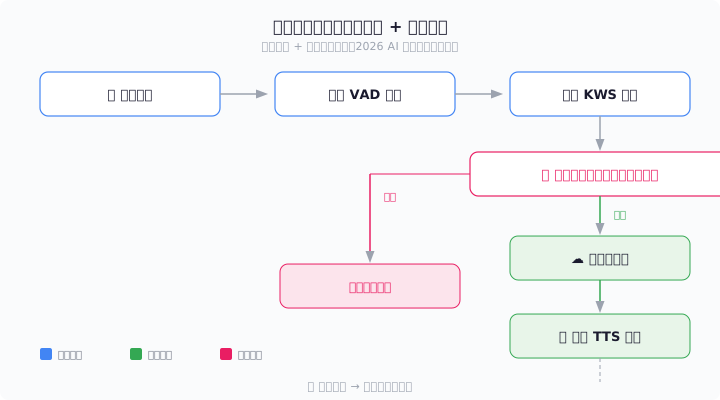
This architecture keeps the product usable on weak networks without giving up the intelligent cloud experience. It is the mainstream technical path for AI toys in 2026.
8. Sovereignty 6: Open Extension (MCP) - AI Capabilities That Keep Evolving, Without Vendor Lock-In
Deliverables
Native support for MCP (Model Context Protocol)
A standardized tool-calling interface
Existing tool library: weather, music, calculator, translation, stories and knowledge lookup
Documentation for connecting the brand owner's own in-house tools
What does this give the brand owner?
(1) Capabilities that keep expanding
The AI toy capability everyone wanted in 2024 was voice conversation. In 2025 it was recognizing the world around you. In 2026 it is emotion recognition plus multimodal interaction. What will 2027 bring? Nobody knows.
MCP on the LX Series lets an AI toy's capabilities keep expanding: no device swap, no module swap, just connect a new tool in the cloud:
| Timing | New capability | MCP tool |
|---|---|---|
| 2026 Q3 | Weather, news | QWeather, news APIs |
| 2026 Q4 | Music playback | QQ Music, NetEase Cloud Music |
| 2027 Q1 | Photo recognition | In-house vision tool |
| 2027 Q2 | Multilingual conversation | Translation API |
| 2027 Q3 | Personalized recommendations | In-house recommendation engine |
(2) No lock-in to a single model
Multi-model intelligent routing: everyday → DeepSeek, deep reasoning → GPT-4o, emotional → in-house model, creative → Claude
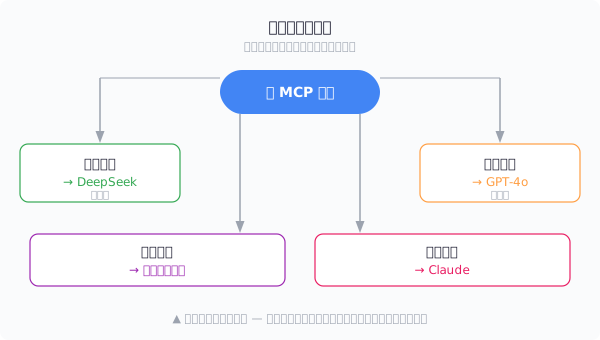
The routing logic is defined by the brand owner and can be tuned against cost, performance and brand tone.
(3) The brand owner's own tools
In the Dongxiaobao case we connected an insurance-industry "compliance engine" as an MCP tool. It was built in-house by the brand, and once connected it became the AI assistant's compliance checking capability.
The MCP extension capability of the LX Series lets a brand owner's own know-how feed back into the AI toy. That is something a module cloud platform solution simply cannot do.
9. Cross-Industry Validation: What Does the Dongxiaobao Case Prove?
Dongxiaobao is an AI assistant Nablai built for the insurance brokerage industry on the LX platform. The point of this case is not insurance itself; it is the proof that the six sovereigns of the LX platform are a capability foundation that can be reused across industries.
The compliance challenges Dongxiaobao faced
| Challenge | How the LX platform solves it |
|---|---|
| Insurance data must not leave the client's private environment | Sovereignty 4: AMS deployed independently into the brand owner's private cloud |
| A knowledge base of tens of thousands of insurance products | Sovereignty 3: a custom LLM plus deep training on a domain knowledge base |
| Mis-selling and compliance risk | Sovereignty 3 + Sovereignty 5: a cloud compliance engine plus on-device sensitive-word blocking |
| Brokers face a high barrier to entry | Sovereignty 3: a custom LLM shortens the training ramp for new hires |
Actual business results
Product lookup efficiency: up 80%
Proposal generation time: 2 hours → 5 minutes
New-hire training period: cut by 50%
Compliance review coverage: 100% (real-time and full-volume vs. manual sampling)
What this case means for toy brands
One set of technical sovereigns reused across industries: insurance industry ↔ LX platform ↔ toy industry
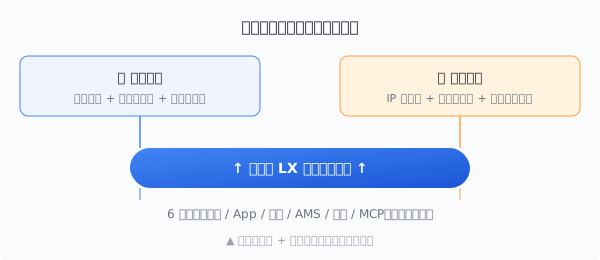
If the LX platform can carry an industry as compliance-heavy and specialized as insurance, the toy industry is well within reach.
10. So How Long Does It Actually Take to Deliver These 6 Sovereignties?
A question many brand owners ask: the six sovereigns sound great, but how long does delivery really take, and what do we have to put in?
The answer is 45 days on average to the first batch of functionality, and 3-4 months for the full delivery. Many stages run in parallel: account deployment and app development at the same time, model fine-tuning and module integration testing at the same time.
Standard delivery timeline (parallel mode)
| Stage | Duration | Parallel notes | What the brand owner provides |
|---|---|---|---|
| Requirements gathering + solution design | 2-3 weeks | Stage 1 | Product + operations leads |
| Account system + AMS console | 2-3 weeks | Stage 2 | |
| Three tracks in parallel | Cloud environment + test accounts | ||
| App development (LX SDK) | 45 days on average | UI/UX designs + app store account | |
| LLM fine-tuning | 3-4 weeks | Conversation samples + persona definition | |
| Module integration testing + gray release | 3-4 weeks | Stage 3 | Toy ID + beta users |
| Mass production | - | Wrap-up | Production handoff |
Total timeline: roughly 3-4 months (from kickoff to mass production, with three stages running in parallel)
A brand owner with its own app team can compress that to 2-3 months. Even with a fully custom build, the parallel model keeps delivery inside 4-5 months.
The key insight: the six sovereigns are not a serial pipeline. Account deployment, app development and model fine-tuning all move forward at once, and the bottleneck is app development (45 days on average), not anything else. That is why "45 days on average" is the core delivery commitment of the LX Series.
Recommended resource commitment
| Brand owner resource | Commitment level | Description |
|---|---|---|
| Product lead | 50% x full duration | Owns product definition and launch cadence |
| Operations lead | 30% x full duration | User operations, content operations, data analysis |
| App development (optional) | 100% x 8 weeks | If you go with the white-box SDK model |
| Legal / compliance | Part-time | Privacy policy, user agreement, compliance review |
Which brand owners is this right for?
| A good fit | Not a good fit |
|---|---|
| Brands that want to own the user relationship themselves | Brands that only want a one-off hardware sale |
| Brands with a distinct IP tone that need a differentiated AI persona | White-label players with no clear IP positioning |
| Growth-stage brands selling 10,000+ units a month | Brands still testing the water with unstable volumes |
| Running global expansion and a domestic business at the same time | Single channel, single market |
| Long-term players with a 3-year-plus plan | Short-term opportunists who will not invest in operations |
11. In Closing: These 6 Sovereignties Are Not a Technology Checklist, They Are a Choice of Business Model
Back to the question we opened with: once you have sold 100,000 AI toys, have you accumulated a user asset, or have you built someone else's business?
The answer does not depend on hardware specs. Anyone can buy an ESP32, microphone array pricing is transparent, and motor driver designs are broadly similar. The answer depends on control:
Whose database does the user data accumulate in?
Who defines the AI persona?
Whose account does the app store listing belong to?
What ratio is the subscription revenue split on?
Who drives content operations?
What the six sovereigns of the LX Series set out to do is write the answers to those five questions into the brand owner's balance sheet.
We are not selling you a module component. We are helping you build an AI capability castle of your own: the walls, the gate and every brick inside it are yours.
The most direct way to understand how the six sovereigns of the LX Series actually get delivered is to look at a real client's full implementation. Dongxiaobao is one of the most complete cases we have done: work backwards from insurance to the toy industry and you will find the underlying logic is exactly the same.
*Further reading:*
AI Toy Module Selection Guide: LX Series vs TY Series
LX Series: Brand as a Platform
Case study: How Dongxiaobao built an insurance AI assistant on the LX platform
Shenzhen Nablai Intelligent Technology Co., Ltd. - Smart toy AI module specialists
📧 contact@nablai.com.cn 🌐 www.nablai.com.cn
Shenzhen Nablai Intelligent Technology Co., Ltd. — AI module specialists for smart toys
📧 contact@nablai.com.cn 🌐 www.nablai.com.cn