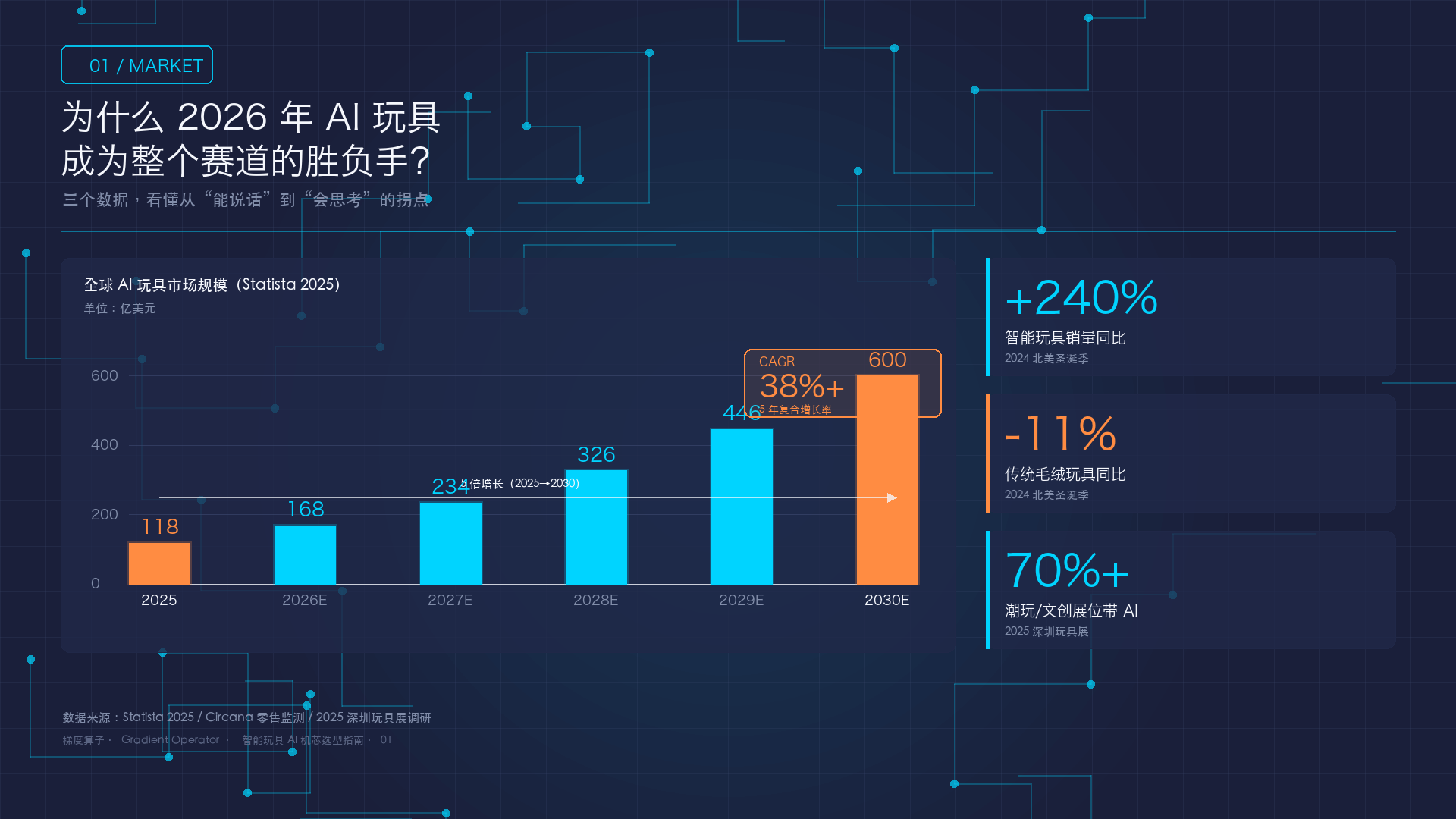
Over the past three years the biggest variable in the toy industry has not been IP or channels, it has been "becoming smart". One set of numbers makes the point: according to Statista's 2025 report,the global AI toy market is worth around USD 11.8 billion and is expected to pass USD 60 billion by 2030, a CAGR of more than 38%. Over the 2024 North American holiday season, sales of smart toys with voice interaction rose 240% year on year, while traditional plush toys fell 11%. At the 2025 Shenzhen Toy Fair, more than 70% of the designer toy and cultural-creative booths were showing samples that could "talk" - the AI module is close to standard equipment now.
But the pain on the manufacturer's side is just as real: AI capability sounds exciting, yet delivering it means pulling on six threads at once - compute, power consumption, connectivity, cloud, languages and compliance. Pick the wrong platform and you are remaking inventory, redoing certification and getting stuck at customs.
An "AI module" is a board or module that packages all of this up, the "brain + heart + nervous system" of a smart toy. Pick the right module and you save on the order of RMB 1 million in trial-and-error costs over six months; pick wrong and the whole product definition goes back to the drawing board.
Shenzhen Nablai Intelligent Technology Co., Ltd. focuses on exactly this link in the chain - the AI module -TY Series (built on the Tuya platform)is aimed at overseas expansion and multilingual support,LX Series (based on ESP32)is aimed at high local performance and customization. This article works through both lines and gets the selection decision properly settled.
1. Six core dimensions for choosing an AI module
Before comparing TY and LX, let us put the evaluation framework in place. No AI module proposal gets around these six dimensions:
| Dimension | Key question | What it affects |
|---|---|---|
| Compute | How much NPU/DSP compute does the main chip have? Is it enough for on-device voice or vision inference? | Determines whether an on-device LLM can run at all |
| Connectivity | Does it support Wi-Fi / Bluetooth / 4G Cat.1? Is provisioning simple? | Determines the first-time user experience |
| Voice | Does it support offline wake? Switching between languages? Child voice synthesis? | Sets the ceiling on the interaction experience |
| Vision | Camera resolution / frame rate / on-device recognition capability? | Determines whether you can build a toy that "sees" |
| Compliance | Does it carry GDPR / COPPA / CCC / FCC / EN71 pre-certification? | Determines whether you can get listed overseas |
| Cost | Total cost of ownership across BOM, module and annual cloud service fees | Determines your gross margin |
Lay these six dimensions out before you look at what is on the market and80% of the indecision disappears on its own。
2. TY Series: a global module built on the Tuya platform
2.1 Core positioning
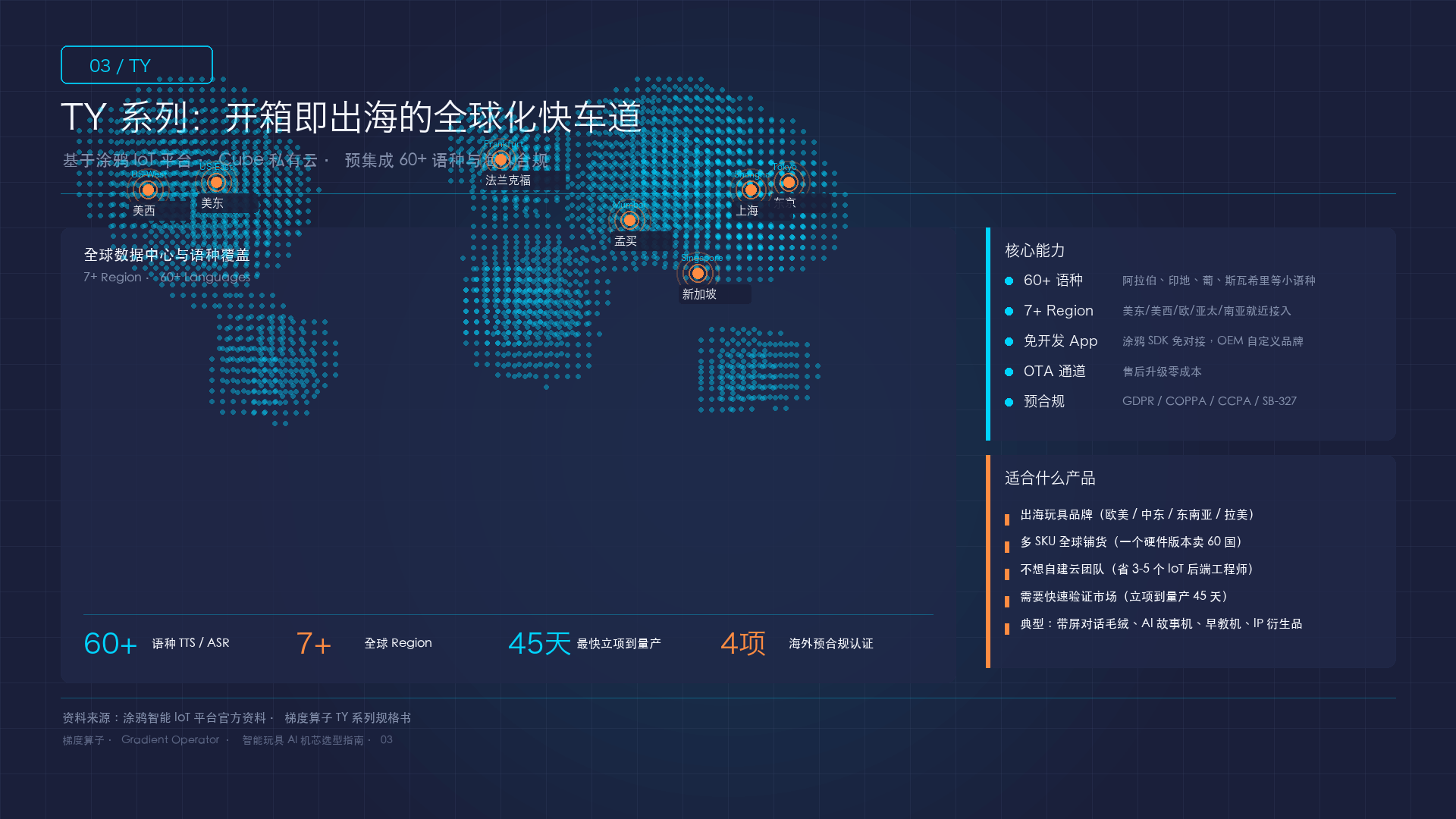
The TY Series is a product line Nablai co-developed withTuya Smart (Tuya)through deep joint R&D, with the Tuya IoT platform and Cube private cloud pre-integrated.Its defining feature is "ready to ship overseas out of the box":
- 60+ languages for TTS / ASR, ready to use on first power-up, including lower-frequency languages such as Arabic, Hindi, Portuguese and Swahili
- Tuya global data centers (7+ regions, including US East, US West, Frankfurt, Singapore, Tokyo, Mumbai and Shanghai)
- Tuya App SDK integrates with no development work, and OEM customers can apply their own branding
- Pre-compliance with overseas regulations including GDPR, COPPA, CCPA and California SB-327
- Built-in OTA channel, so after-sales updates cost nothing
2.2 What it suits
- Toy brands going overseas: Europe, the US, the Middle East, Southeast Asia and Latin America are all TY's sweet spot
- Multi-SKU global rollout: you want one hardware version to sell in 60 countries
- No in-house cloud team: saves the cost of 3-5 IoT backend engineers
- Need to validate the market fast: an average of 45 days from project kickoff to mass production
2.3 Typical applications
Screen-equipped conversational plush toys, AI storytellers, early-learning devices for children, hit cross-border e-commerce IP merchandise, and custom giveaways for overseas retail chains.
3. LX Series: a high-performance customizable module built on ESP32

3.1 Core positioning
The LX Series is built onEspressif ESP32-S3 / ESP32-P4 and other high-performance parts. Its defining characteristics are "strong performance, highly customizable, ready for a camera and 4G":
- Clock speed up to 240 MHz, dual core with AI acceleration instruction set, able to run lightweight YOLO, face and gesture recognition on-device
- Supports DVP / MIPI-CSI camera input, up to 5 MP at 30 fps
- An external 4G Cat.1 module can be added, freeing the device from Wi-Fi and covering outdoor, in-car and mobile scenarios
- SDK is fully compatible with Arduino / ESP-IDF / PlatformIO, so hardware engineers get up to speed quickly
- No cloud lock-in: on-device inference, private cloud or public cloud - your choice
3.2 What it suits
- AI toys that need camera recognition: expression recognition, AR interaction, reading picture books, AI photo learning
- Scenarios that need 4G connectivity: outdoor adventure toys, in-car companions, emergency communication, pet tracking
- IP toys that need deep customization: you want differentiated interaction rather than an off-the-shelf platform
- Domestic B2B projects / government and enterprise cultural-creative customization: data localization and private deployment
3.3 Typical applications
Camera-equipped AI early-learning robots, designer figures that recognize and explain what they see, outdoor camping AI speakers, in-car AI companion toys, and AR interactive museum merchandise.
4. TY vs LX: a six-dimension deep comparison

| Dimension | TY Series (Tuya platform) | LX Series (ESP32) |
|---|---|---|
| Compute | Mainstream ARM Cortex-A / RISC-V with NPU, focused on cloud coordination | ESP32-S3 / P4, focused on on-device inference and customization |
| Voice | Cloud TTS/ASR in 60+ languages; offline wake optional | On-device multilingual ASR; flexible cloud TTS |
| Connectivity | Wi-Fi + Bluetooth Mesh (Tuya ecosystem) | Wi-Fi + Bluetooth + 4G Cat.1 (add-on) |
| Vision | Screen-first; a small camera can be attached | Native support for a 5 MP camera with on-device recognition |
| Global | 60+ languages + 7+ regions of data centers + overseas pre-certification | You handle overseas compliance and cloud deployment yourself |
| Customization | Moderate (bounded by the Tuya platform) | Deep customization (full hardware / software / cloud stack) |
| Time to get started | 2-4 weeks | 4-8 weeks |
| Best-fit stage | Fast overseas launch / multi-SKU rollout | Differentiated products / high-end customization / 4G scenarios |
5. Three technology trends for smart toys in 2026
6. Choosing by scenario: a three-minute decision checklist
Overseas / global → TY first | Domestic / government and enterprise / private deployment → LX first
No, voice interaction only → either TY or LX | Needs visual recognition → LX first
No, Wi-Fi only → either TY or LX | Outdoor / in-car / mobile scenarios → LX first (with add-on 4G)
Mass production within 2 months → TY first | More than six months with differentiation requirements → LX first
No, the supplier handles the cloud → TY first | An IoT team of 3 or more → LX first
If three or more of the five questions point to TY,go with TY; and the same in reverse.The two families can also be combined: run LX as the main controller for differentiated interaction while using the Tuya ecosystem in the cloud for overseas user operations - a "two-line strategy" many leading brands already use.
7. In closing
In the second half of the smart toy game,the competition is no longer about whether you can cram an AI inside, but about whether you picked the right AI module. The selection decision directly affects time to market, compliance risk, user reputation and gross margin.
Nablai's TY and LX families cover exactly the two mainstream paths: the fast lane to global markets and the deep customization track. If you are choosing a module for your next product, bring us a description of your requirements (target market, whether you need a camera, whether you need 4G, roughly when you go to mass production) and our team will give youa free selection assessment and BOM quotation。